
Why subfloor levelling matters
Many “floor problems” are actually subfloor problems. Uneven slabs can cause visible joints, creaks, hollow spots, and premature wear. A self-levelling screed creates a consistent plane—so your floor locks, bonds, and sits correctly.
- Improves flatness for a clean, premium finish
- Reduces squeaks, movement, and joint stress
- Helps prevent gaps and edge lifting over time
- Supports correct adhesive coverage for glue-down floors
- Creates a safer, more comfortable surface underfoot
When do we recommend it?
If we find visible ridges, dips, old tile glue lines, patchy repairs, or an uneven screed, our team will recommend self-levelling so your floor installs to manufacturer tolerances.

Application control: the toothed rake helps control thickness—here a 2mm rake is used.

Freshly poured leveller begins to flow and settle—then cures to a smooth, flat finish.
The process (simple, fast, reliable)
Self-levelling compounds are designed to flow into low spots and create a uniform surface with minimal disruption. In most homes and apartments, this is typically a one-day job.
1
Assessment & surface prep
We check flatness, remove loose material, clean dust, and prepare the surface for bonding.
2
Priming (where required)
Primer improves adhesion and helps the leveller cure consistently—especially on absorbent or tricky substrates.
3
Mixing with the right equipment
A specialised mixer creates a uniform, lump-free slurry to avoid weak spots and ridges.
4
Pour, spread, and level
The compound is poured and guided with a toothed rake; the tooth size controls thickness and coverage.
5
Curing window
~6 hours: typically walkable.
~24 hours: typically ready for flooring installation.
~24 hours: typically ready for flooring installation.
Note: drying times vary with temperature, ventilation, substrate, and thickness. Decomagna will advise the correct timing on site.

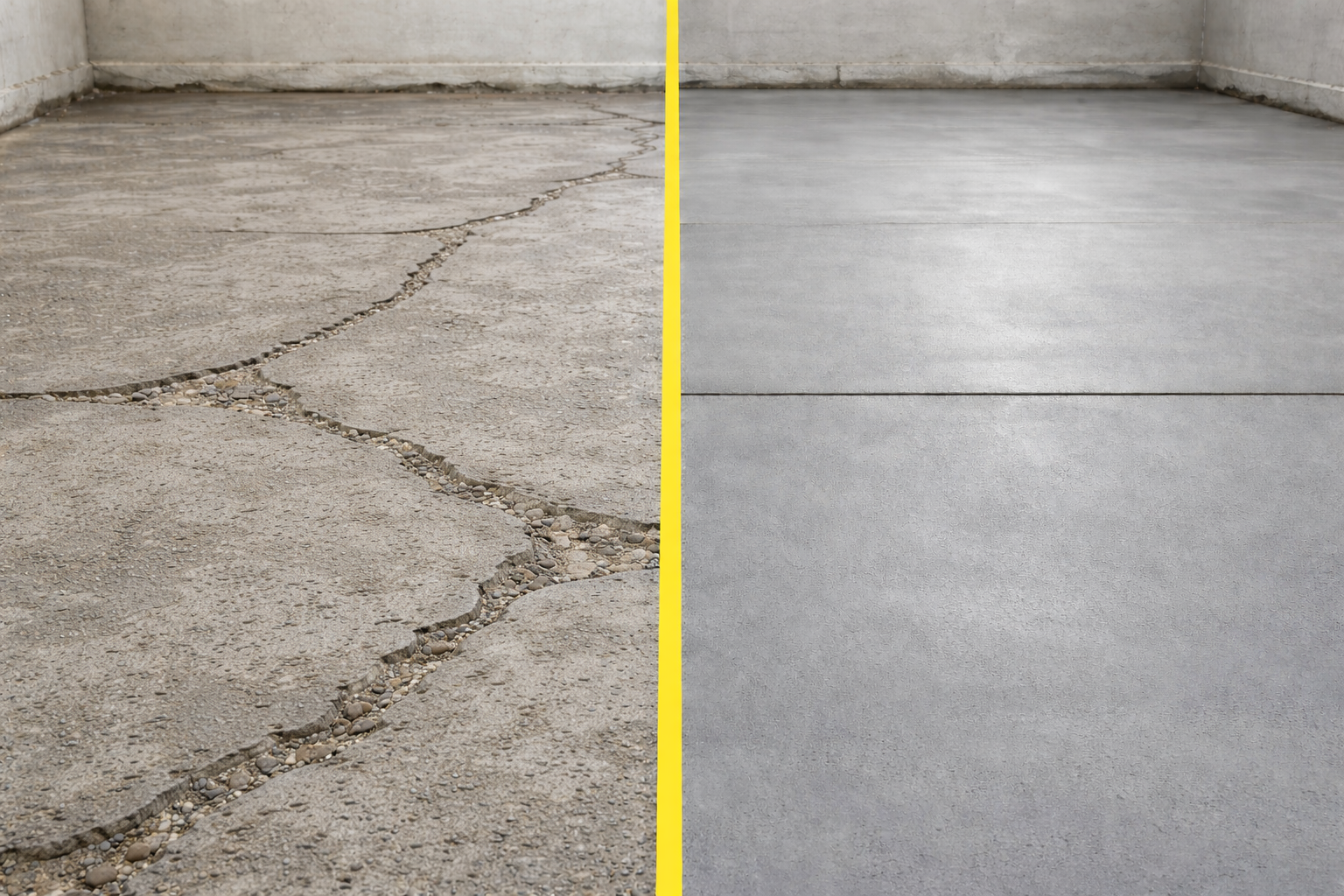
Before & after: levelling removes unevenness so your new floor installs on a consistent surface.
Typical timing summary
On-site work
~1 day
Walkable
~6 hours
Install floor
~24 hours
Why it’s especially important for each flooring type
Different floors react differently to uneven subfloors—but all premium finishes demand flatness. Here’s what levelling protects you from.
| Flooring type | What unevenness can cause | How self-levelling helps |
|---|---|---|
| Laminate | Joint stress, “bounce,” creaks, gapping, edge damage over time | Creates a stable plane so click-locks stay tight and supported |
| SPC | Telegraphing (subfloor lines showing through), joint movement, hollow spots | Smooths ridges/dips so SPC sits flat and looks premium |
| LVT (vinyl) | Telegraphing, adhesive failures in low/high spots, visible imperfections | Provides a uniform surface for even bonding and a flawless look |
| Engineered wood | Uneven glue lines, hollow sounds, stress points, imperfect herringbone lines | Improves glue-down performance and keeps patterns crisp and aligned |
If your project includes herringbone, brass inlays, contour detailing, or tight joints, flatness becomes even more critical.
Self-levelling vs traditional cementitious screeding
Traditional cement work can be effective, but it’s more labour-intensive, harder to achieve true flatness, and typically needs longer curing. Self-levelling compounds are engineered for speed and precision—ideal for modern floor installations.
- More consistent flatness (better for click systems and glue-down floors)
- Cleaner application with controlled thickness
- Faster turnaround: walkable in hours, install-ready sooner
- Excellent for smoothing tile lines, patchy repairs, and small undulations
Quick checklist: do you need levelling?
You see ridges or dips
Even small variations can show through SPC/LVT and stress laminate joints.
Old tile glue lines / patchy repairs
Levelling smooths the surface so your new floor looks uniform.
You want a premium finish
Especially for herringbone, engineered wood, and tight seam work.
Not sure? Decomagna can assess your subfloor and advise the correct preparation.
Need floor levelling before installation?
Decomagna offers self-levelling floor preparation on request. If your project needs it, our team will recommend it upfront and plan the work so your installation stays on schedule.
Talk to us
Add your phone/email/WhatsApp here, or swap this section for your website’s contact form component.
Service
Subfloor screeding / self-levelling
Typical timeline
1 day • Walkable ~6h • Install ~24h